
Log In
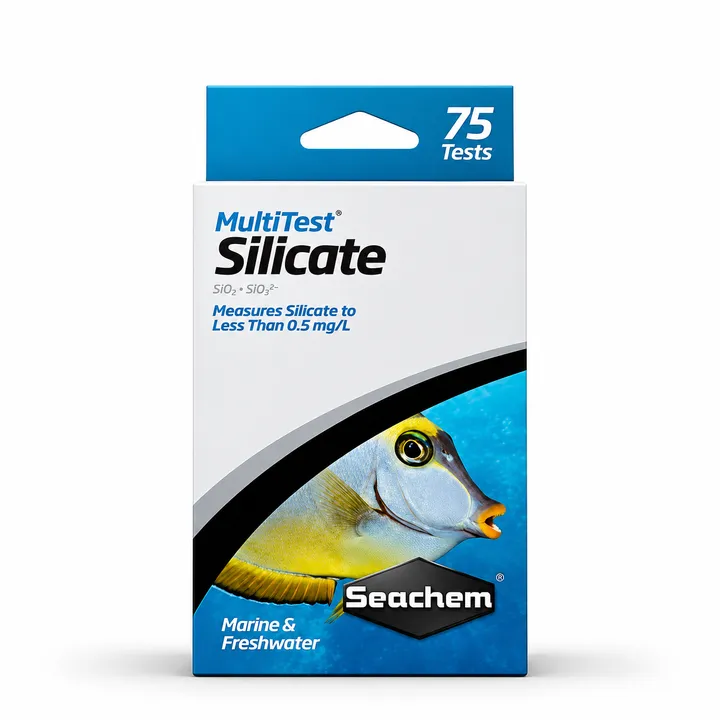
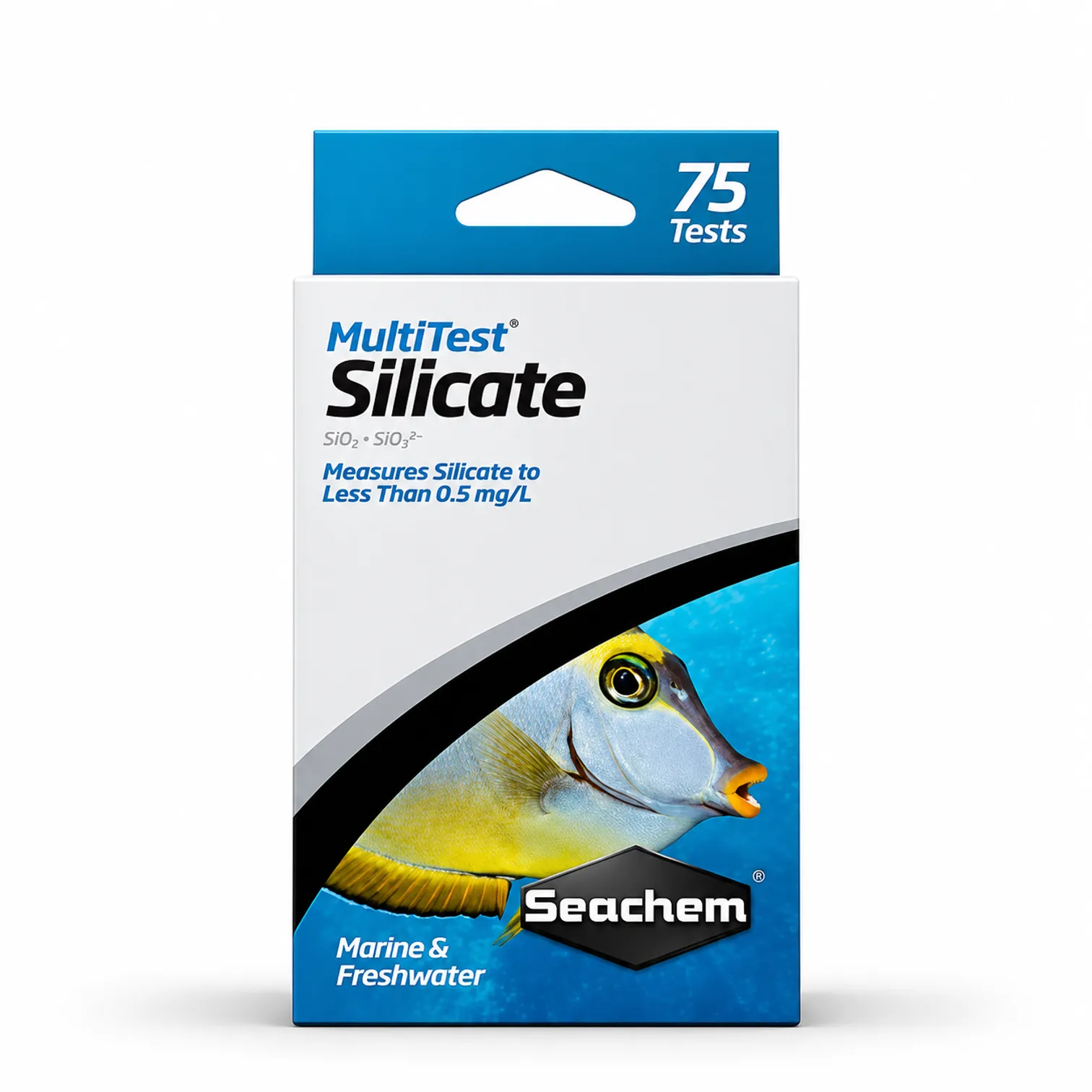
Seachem MultiTest Silicate
Secure Checkout
Free Shipping*
Expert Support
Quality Guaranteed
7-Day Easy Returns. View Policy
Product Details
Description
Seachem MultiTest Silicate Test Kit – 75 Tests | High-Sensitivity Aquarium Silicate Testing for Marine, Reef & Freshwater Aquariums
Product Description
Monitor dissolved silicate concentrations and maintain balanced aquarium water conditions with Seachem MultiTest Silicate, a professional aquarium silicate water testing kit designed for freshwater, marine, and reef aquariums.
Buy Seachem MultiTest Silicate Test Kit Online in India at Aquatik Angels – Your Trusted Online Aquarium & Aquascaping Store in India and Chennai.
Manufactured by Seachem Laboratories, MultiTest Silicate is a high-sensitivity aquarium water testing kit that helps aquarists measure soluble silicate concentrations, investigate brown diatom algae growth, and monitor important water-quality conditions.
Silicates naturally occur in freshwater and seawater and may enter aquariums through tap water, replacement water, mineral-based substrates, rocks, and other sources.
In marine and reef aquariums, elevated available silicate can contribute to the growth of diatoms, commonly observed as brown or golden-brown deposits on aquarium glass, sand, rocks, and decorations.
Seachem MultiTest Silicate measures soluble silicate concentrations from 0–25 mg/L, with detection sensitivity below 0.5 mg/L.
Seachem recommends maintaining silicate concentrations at approximately 1 mg/L or less in marine and reef aquariums to help minimize diatom growth.
The kit provides over 75 tests and includes a six-cavity testing plate, low-range cuvette, colour chart, reference sample, and dedicated testing reagents.
Its sensitive testing system makes it useful for checking aquarium water, evaluating replacement water quality, and investigating possible silicate accumulation.
Suitable for marine aquariums, reef tanks, freshwater aquariums, saltwater fish-only systems, aquarium source-water testing, and professional aquarium maintenance, Seachem MultiTest Silicate provides valuable information for effective aquarium water-quality management.
Key Features & Benefits
1. High-Sensitivity Silicate Testing
Measures soluble silicate concentrations in aquarium water.
2. Over 75 Tests
Provides extensive testing capacity for regular aquarium water-quality monitoring.
3. Low-Level Silicate Detection
Detects silicate concentrations below 0.5 mg/L.
4. Measurement Range of 0–25 mg/L
Suitable for testing a wide range of soluble silicate concentrations.
5. Freshwater & Marine Compatibility
Designed for use in both freshwater and saltwater aquarium systems.
6. Reef Aquarium Water Monitoring
Helps reef aquarium owners monitor silicate concentrations associated with diatom growth.
7. Brown Diatom Investigation
Supports identifying silicate availability when brown diatoms develop on aquarium surfaces.
8. Aquarium Source-Water Testing
Useful for checking silicate concentrations in tap water and aquarium replacement water.
9. Reference Sample Included
Allows users to verify test performance using a known reference.
10. Low-Range Cuvette Included
Supports measurement of low silicate concentrations.
11. Six-Cavity Testing Plate
Allows multiple samples to be prepared and evaluated during one testing session.
12. Easy-to-Read Colour Chart
Includes a viewing window to assist with accurate colour interpretation.
13. Professional Aquarium Maintenance
Suitable for routine aquarium testing and water-quality troubleshooting.
14. Convenient Testing Equipment
Includes the necessary reagents and accessories for performing silicate measurements.
15. Informed Water-Quality Management
Provides measurements that can support decisions about filtration, source water, and aquarium maintenance.
Technical Specifications
| Specification | Details |
|---|---|
| Brand | Seachem |
| Manufacturer | Seachem Laboratories |
| Product Name | MultiTest Silicate |
| Product Category | Aquarium Water Testing |
| Product Type | Chemical Silicate Test Kit |
| Parameter Tested | Soluble Silicate |
| Testing Capacity | Over 75 Tests |
| Measurement Range | 0–25 mg/L |
| Detection Sensitivity | Below 0.5 mg/L |
| Colour Chart Increments | 0.01–0.1 mg/L and 0.1–1 mg/L |
| Aquarium Compatibility | Freshwater & Marine |
| Testing Method | Chemical Colour Development |
| Simultaneous Testing | Up to 6 Samples |
| Multi-Cavity Test Plate | Included |
| Low-Range Cuvette | Included |
| Reference Sample | Included |
| Primary Application | Aquarium Silicate Monitoring |
Understanding Silicate in Aquarium Water
Silicate refers to a group of silicon-containing compounds naturally present in aquatic environments.
Dissolved silicate is found in both freshwater and marine water.
Natural seawater can contain approximately 10 mg/L silicate, although actual concentrations vary with location and environmental conditions.
Silicate is generally not considered directly toxic to aquarium fish and invertebrates at typical aquarium concentrations.
However, available silicate can influence the growth of certain organisms, particularly diatoms.
Seachem MultiTest Silicate measures soluble silicate and reports the result as a silicate concentration.
According to Seachem, the silicate result can be converted to an approximate silicon concentration using:
Silicon (mg/L) = Silicate (mg/L) × 0.3
Why Silicate Testing Is Important
Monitoring silicate is particularly useful in marine and reef aquariums when diatom growth is persistent or unusual.
Silicate testing can help aquarium owners:
-
Investigate brown diatom deposits
-
Evaluate aquarium source-water quality
-
Monitor silicate concentrations following water changes
-
Assess possible silicate accumulation
-
Review aquarium filtration practices
-
Monitor newly established marine systems
-
Evaluate water-quality trends
-
Support professional aquarium maintenance
A silicate measurement provides information about one aspect of aquarium water chemistry.
It does not independently identify every cause of algae growth or water-quality problems.
Understanding Brown Diatom Algae
Diatoms are microscopic organisms that use dissolved silica to build their cell walls.
They frequently appear as brown or golden-brown films on aquarium surfaces.
Common locations include:
-
Aquarium glass
-
Sand beds
-
Rocks
-
Artificial decorations
-
Substrates
-
Aquarium equipment
Diatoms are frequently observed in newly established marine aquariums.
They may also occur in mature aquariums when suitable nutrients and environmental conditions are available.
Silicate is one factor that can support diatom growth.
However, diatom development is also influenced by lighting, nutrient availability, aquarium maturity, and biological processes.
Seachem MultiTest Silicate helps determine whether measurable dissolved silicate is present, providing useful information when investigating persistent diatoms.
Silicate Levels in Marine & Reef Aquariums
Seachem recommends maintaining silicate concentrations at 1 mg/L or below in marine and reef aquariums to help minimize diatom growth.
This recommendation is intended to support nutrient management.
Actual silicate concentrations may vary depending on:
-
Source water
-
Salt mix
-
Water changes
-
Aquarium substrates
-
Biological consumption
-
Filtration systems
-
Aquarium maturity
Aquarium owners should use testing results alongside observations and other water-quality parameters.
Silicate in Freshwater Aquariums
Silicate is naturally present in many freshwater sources.
Seachem notes that freshwater silicate concentrations commonly fall around 4–20 mg/L.
These concentrations are not necessarily harmful to freshwater aquarium livestock.
Silicate is generally less critical as a routine freshwater water-quality parameter.
However, testing may be useful when investigating persistent diatoms or checking replacement water.
A measurable silicate reading in freshwater does not automatically indicate that corrective action is necessary.
How Seachem MultiTest Silicate Works
The test kit uses specialized chemical reagents that react with silicate present in aquarium water.
The reaction produces a colour that can be evaluated using the supplied silicate colour chart.
The kit includes a low-range cuvette for evaluating low silicate concentrations and an opaque multi-cavity testing plate for sample handling.
The result is reported as a concentration in mg/L.
For reliable readings, users must follow the correct sample volumes, reagent sequence, mixing procedures, and reaction times specified by Seachem.
How to Use Seachem MultiTest Silicate
Step 1 – Prepare the Testing Equipment
Ensure the multi-cavity testing plate, sample pipette, low-range cuvette, and stirring rod are clean.
Step 2 – Collect Aquarium Water
Use the supplied sample pipette to collect aquarium water.
Step 3 – Prepare the Sample
Transfer the specified volume into the appropriate testing vessel.
Step 4 – Add Silicate Reagent 1a
Follow the manufacturer's instructions for adding the required amount.
Step 5 – Add Silicate Reagent 1b
Carefully add Reagent 1b according to the prescribed procedure.
Step 6 – Add Silicate Reagent 2
Continue the chemical testing procedure using the specified quantity.
Step 7 – Add Silicate Reagent 3
Use Reagent 3 at the stage indicated in the official instructions.
Step 8 – Mix the Sample
Use the supplied stirring rod as directed.
Step 9 – Allow Colour Development
Wait for the manufacturer's specified reaction time.
Step 10 – Read the Result
Compare the developed sample colour with the supplied silicate colour chart.
Step 11 – Record the Silicate Concentration
Record the result in mg/L with the testing date.
Step 12 – Clean & Store
Dispose of the tested solution safely and clean the testing accessories.
Important: Always follow the exact reagent quantities, order, and reaction times given in the manufacturer's instructions. Do not estimate reagent amounts.
Using the Silicate Reference Sample
The kit includes a silicate reference sample containing a known concentration.
This can be used to check whether the test is performing as expected.
Reference Testing Procedure
-
Select the supplied reference sample.
-
Use it in place of aquarium water.
-
Perform the test according to the normal instructions.
-
Compare the result with the reference's stated value.
-
Review the testing procedure if the result differs significantly.
Reference testing is especially useful when readings appear inconsistent.
The reference sample is intended for test validation and must not be added directly to aquarium water.
Understanding the Low-Range Cuvette
The low-range cuvette supports testing when low silicate concentrations need to be evaluated.
This is particularly relevant to marine and reef aquarium monitoring, where relatively low concentrations may be important.
Use the cuvette only as directed by Seachem.
Keep it clean and free of reagent residue between tests.
Understanding the Multi-Cavity Testing Plate
Seachem MultiTest Silicate includes an opaque white multi-cavity testing plate.
The six cavities accommodate multiple samples during one testing session.
The supplied colour chart includes a viewing window to support clear interpretation.
This design is useful for aquarium hobbyists who maintain multiple tanks and for professional aquarium maintenance services.
Seachem MultiTest Silicate for Reef Aquariums
Reef aquariums require careful nutrient and water chemistry management.
Silicate monitoring is useful when diatom growth becomes persistent or when the quality of replacement water is uncertain.
The Seachem test kit allows reef aquarium owners to monitor dissolved silicate concentrations.
Regular testing may help identify trends following water changes, filtration adjustments, or changes in water source.
Additional measurements of phosphate, nitrate, alkalinity, calcium, magnesium, and salinity may also be necessary for overall reef aquarium maintenance.
Seachem MultiTest Silicate for Marine Fish-Only Aquariums
Marine fish-only aquariums may contain silicate introduced through water changes and mineral sources.
Diatom growth may appear on glass, decorations, rocks, and sand beds.
Seachem MultiTest Silicate helps evaluate soluble silicate concentrations during water-quality troubleshooting.
It is especially useful when investigating repeated brown diatom deposits.
Seachem MultiTest Silicate for New Marine Aquariums
Newly established marine aquariums often experience changes in biological activity and nutrient availability.
Brown diatom films are common during aquarium maturation.
Silicate may contribute to this growth, although aquarium maturity and other nutrients also influence the process.
Testing can help aquarium owners assess dissolved silicate levels.
A newly established aquarium should also be monitored for ammonia, nitrite, nitrate, salinity, and other relevant parameters.
Seachem MultiTest Silicate for Freshwater Aquariums
Freshwater aquariums may contain naturally occurring silicate from tap water.
Silicate testing can help when investigating brown deposits or assessing source-water chemistry.
However, many freshwater aquariums operate normally with measurable silicate.
Avoid unnecessary chemical treatments based solely on a silicate reading.
Testing Aquarium Source Water
Replacement water can introduce dissolved silicate into aquarium systems.
Testing source water may help identify whether silicate is being introduced during water changes.
Potential sources include:
-
Tap water
-
Mineral-rich freshwater
-
Inadequately purified RO water
-
Exhausted DI resin systems
-
Water used for preparing marine saltwater
When investigating a possible source-water issue, test both the aquarium and its replacement water under comparable conditions.
Silicate & RO/DI Water Purification
RO/DI filtration systems are commonly used for preparing water for reef aquariums.
Their performance depends on membrane condition, water pressure, resin condition, and other factors.
Some forms of silicate may remain in treated water when filtration is inadequate or DI media becomes exhausted.
Seachem MultiTest Silicate can help assess silicate concentrations in prepared water.
When elevated concentrations are detected, inspect the purification system and replace filtration components where necessary.
A zero-TDS reading alone does not always provide a complete assessment of every dissolved contaminant.
What to Do When Silicate Is Elevated
If silicate is higher than the desired range for a marine or reef aquarium:
-
Confirm the reading using the correct test procedure.
-
Check the silicate concentration in replacement water.
-
Inspect RO/DI filtration performance.
-
Review recent changes to substrates, rocks, or decorations.
-
Evaluate the aquarium's diatom growth.
-
Perform appropriate water changes with suitably purified water when beneficial.
-
Review suitable filtration or silicate-removal methods if needed.
-
Avoid unnecessarily aggressive water-chemistry changes.
-
Continue monitoring the concentration.
Corrective actions should consider the aquarium's livestock and overall water conditions.
Understanding Low Silicate Readings
A low silicate reading may indicate limited dissolved silicate availability.
In reef aquariums, maintaining relatively low silicate can help limit persistent diatom growth.
However, silicate is not generally a directly toxic contaminant at typical concentrations.
Do not assume that every aquarium requires complete silicate elimination.
Interpret results according to the aquarium type and observed conditions.
Cleaning & Maintenance
Proper cleaning helps maintain consistent test performance.
-
Use clean testing equipment.
-
Avoid contamination between reagents.
-
Rinse accessories according to manufacturer instructions.
-
Keep the low-range cuvette clean.
-
Do not interchange reagent bottle caps.
-
Store reference samples separately from reagents.
-
Keep the colour chart dry and clean.
-
Protect testing accessories from chemical residues.
-
Store reagents securely when not in use.
Important Usage Precautions
-
Follow Seachem's official testing instructions.
-
Use the correct reagent sequence.
-
Do not estimate chemical quantities.
-
Never return tested water to the aquarium.
-
Avoid sample contamination.
-
Use reference samples only for validation.
-
Read the colour chart under suitable lighting.
-
Silicate Reagents 1a and 1b contain sulfuric and molybdic acids and are corrosive.
-
The reagents may damage skin, metals, and fabrics.
-
Protect work surfaces during testing.
-
Avoid contact with eyes, skin, and clothing.
-
Do not ingest testing chemicals.
-
If spillage or skin contact occurs, wash thoroughly with water.
-
If chemicals enter the eyes, rinse immediately with water for at least 10 minutes and seek medical attention.
-
Keep away from children and pets.
-
Store securely according to the manufacturer's instructions.
-
The test kit measures silicate but does not remove it from aquarium water.
Frequently Asked Questions
What is Seachem MultiTest Silicate used for?
It measures soluble silicate concentrations in freshwater and marine aquarium water.
How many tests does the kit perform?
Over 75 tests.
What is the silicate measurement range?
0–25 mg/L.
What is the detection sensitivity?
Below 0.5 mg/L.
Can it be used in reef aquariums?
Yes. It is suitable for marine and reef aquarium water testing.
Can it be used in freshwater aquariums?
Yes.
Does the kit measure soluble silicate?
Yes. It measures soluble silicate and reports the result as silicate concentration.
Why is silicate important in reef aquariums?
Available silicate can support diatom growth, making it useful to monitor when brown diatom deposits become persistent.
What silicate level does Seachem recommend for reef aquariums?
Approximately 1 mg/L or less to help minimize diatom growth.
Is silicate directly toxic to aquarium fish?
Seachem states that silicate is generally non-toxic to fish and invertebrates at typical aquarium concentrations.
Can silicate cause brown algae?
Silicate can support diatom growth, but lighting, nutrients, and aquarium conditions also influence diatom development.
Does the kit include a reference sample?
Yes.
Why is the reference sample included?
It allows users to verify test performance using a known concentration.
Does it include a low-range cuvette?
Yes.
Does the kit include a testing plate?
Yes. It includes a six-cavity testing plate.
Can multiple samples be tested simultaneously?
Yes. Up to six samples can be handled in one testing session.
Can I test RO/DI water?
Yes. It can be used to assess soluble silicate in aquarium source water, following the manufacturer's testing instructions.
Can the kit test tap water?
Yes.
Does the kit remove silicate?
No. It is a water-testing kit.
Does it measure phosphate?
No.
Does it measure nitrate?
No.
Does it measure ammonia?
No.
Can this kit be used for new marine aquariums?
Yes. It can help monitor silicate during aquarium establishment.
Is silicate testing necessary for every freshwater aquarium?
Not necessarily. It is most useful when investigating specific water-quality or diatom concerns.
Are the reagents hazardous?
Yes. Reagents 1a and 1b contain corrosive acids and require careful handling.
Is it suitable for professional aquarium maintenance?
Yes. Its testing capacity and accessories make it useful for routine aquarium water-quality checks.
Package Contents
Seachem MultiTest Silicate includes:
-
Silicate Reagent 1a
-
Silicate Reagent 1b
-
Silicate Reagent 2
-
Silicate Reagent 3
-
Silicate Reference Sample
-
Stir Rod
-
Low-Range Cuvette
-
Sample Pipette
-
Silicate Colour Chart
-
Multi-Cavity Test Plate
-
Manufacturer Instructions
Storage & Handling
Store Seachem MultiTest Silicate according to the manufacturer's instructions.
Keep reagent bottles securely closed.
Protect work surfaces when handling chemicals.
Do not transfer reagents into unmarked containers.
Avoid direct skin and eye contact.
Never ingest testing reagents.
Store securely away from children and pets.
For aquarium water testing only.
Why Choose Seachem MultiTest Silicate?
Seachem MultiTest Silicate provides a practical method of monitoring soluble silicate in freshwater, marine, and reef aquariums.
Its high-sensitivity chemical testing system detects silicate concentrations below 0.5 mg/L and measures across a range of 0–25 mg/L.
The included low-range cuvette supports low-concentration testing, while the reference sample helps verify test performance.
With over 75 tests and a six-cavity testing plate, the kit is suitable for repeated aquarium monitoring and professional maintenance.
Silicate testing provides useful information when evaluating source-water quality, investigating persistent diatoms, and managing marine aquarium water conditions.
Why Buy Seachem MultiTest Silicate from Aquatik Angels?
Aquatik Angels is a specialized aquarium and aquascaping store located in Nolambur, Mogappair, Chennai, Tamil Nadu, serving aquarium enthusiasts across India.
We specialize in marine aquariums, reef filtration systems, freshwater planted aquascaping, aquarium water testing, RO/DI equipment, biological filtration media, customized aquarium installations, terrariums, paludariums, and professional aquarium maintenance.
Explore our range of Seachem aquarium test kits, marine aquarium supplies, reef filtration accessories, water purification products, aquarium filtration media, and professional aquascaping equipment.
Buy Seachem MultiTest Silicate Online in India
Looking for Seachem MultiTest Silicate Price in India, Buy Seachem Silicate Test Kit Online, Marine Aquarium Silicate Test Kit Chennai, Reef Aquarium SiO₂ Tester, Brown Diatom Algae Water Testing Kit, or Aquarium Silicate Test Kit India?
Shop Seachem MultiTest Silicate at Aquatik Angels, your online destination for aquarium water testing, marine aquarium equipment, reef filtration systems, and aquascaping supplies.
Visit our aquarium store in Nolambur, Mogappair, Chennai, Tamil Nadu, or order online with Pan-India Shipping to eligible serviceable destinations, including Bengaluru, Hyderabad, Mumbai, Pune, Delhi, Coimbatore, Kochi, and other cities across India.
Enjoy Free Delivery on eligible orders.
Shop Online: www.Aquatikangels.com
Aquatik Angels – A Touch of Nature Indoors.
Best Online Aquarium Shopping in India and Chennai.
Recommended Products
Customer Reviews


NO REVIEWS FOUND