
Log In
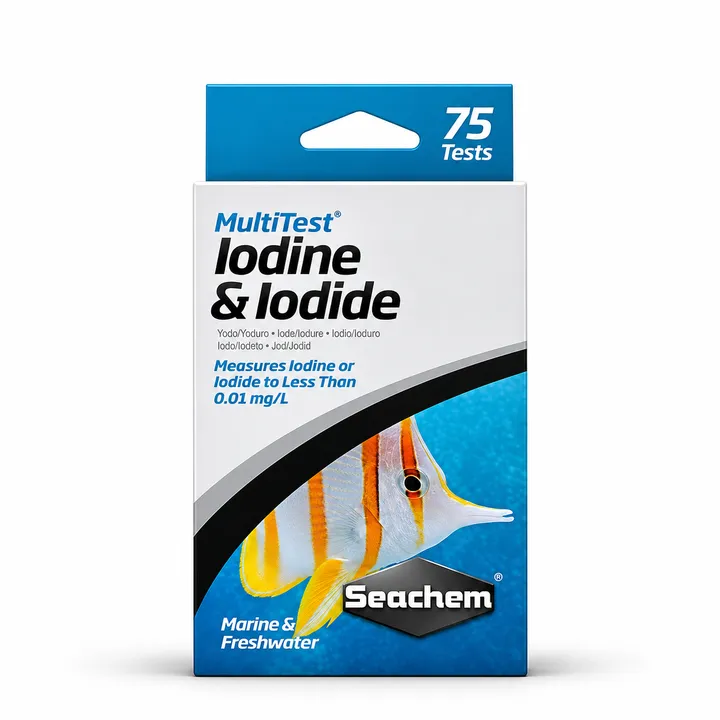
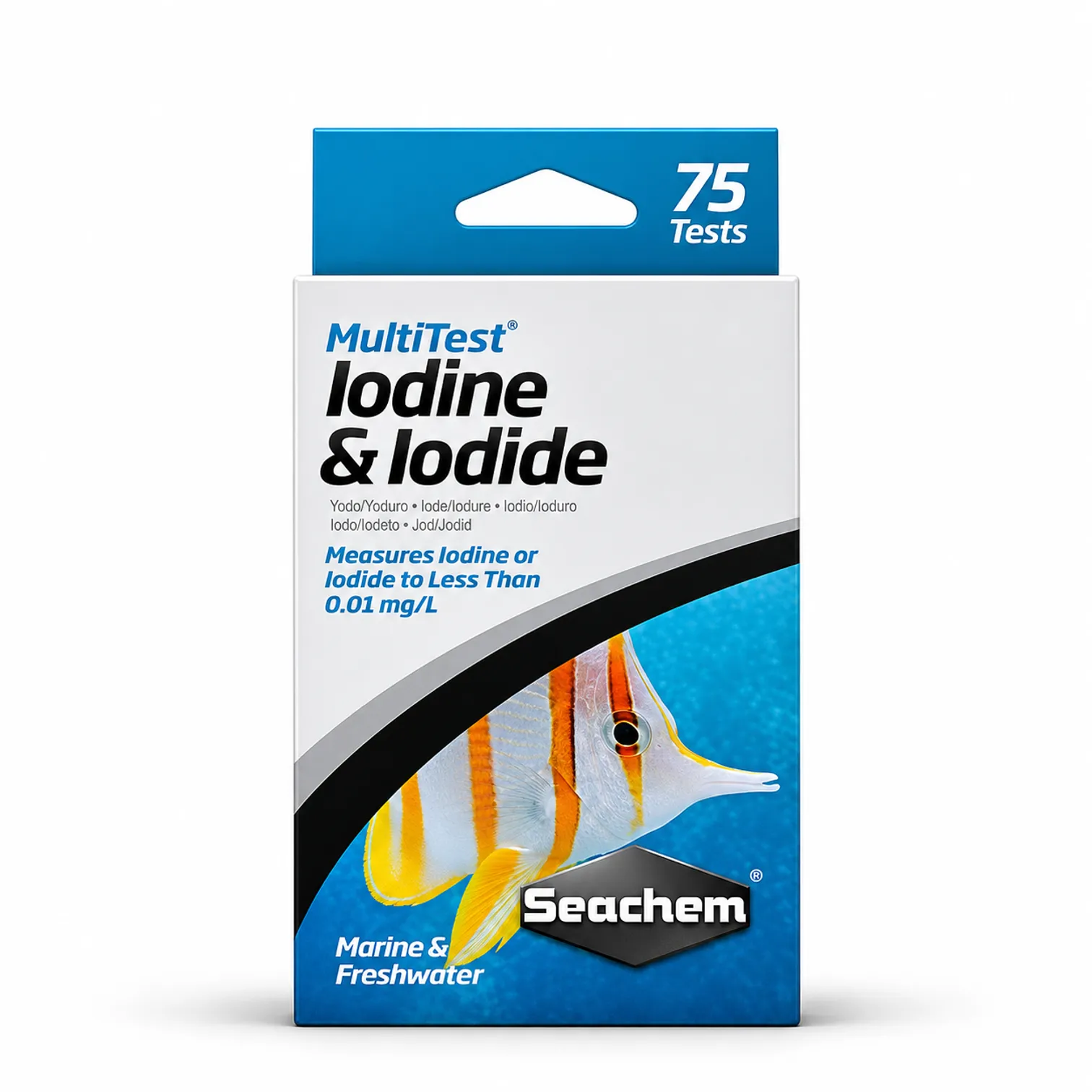
Seachem MultiTest Iodine & Iodide
Secure Checkout
Free Shipping*
Expert Support
Quality Guaranteed
7-Day Easy Returns. View Policy
Product Details
Description
Seachem MultiTest Iodine & Iodide Test Kit – 75 Tests | High-Sensitivity Reef Aquarium Iodine & Iodide Water Testing Kit
Product Description
Maintain balanced marine aquarium water chemistry and monitor essential trace elements with Seachem MultiTest Iodine & Iodide, a professional aquarium iodine and iodide testing kit designed for sensitive trace-element measurement in marine, reef, and freshwater aquariums.
Buy Seachem MultiTest Iodine & Iodide Test Kit Online in India at Aquatik Angels – Your Trusted Online Aquarium & Aquascaping Store in India and Chennai.
Manufactured by Seachem Laboratories, MultiTest Iodine & Iodide uses a sensitive, catalysis-based testing method to measure low concentrations of iodine or iodide in aquarium water.
Iodine is a naturally occurring trace element in seawater and is involved in biological processes within marine ecosystems.
Monitoring iodine-related compounds can be particularly useful in reef aquariums containing soft corals, hard corals, marine invertebrates, and other organisms.
Natural seawater typically contains approximately 0.06 mg/L iodide, providing a useful reference for reef aquarium trace-element management.
Seachem recommends maintaining iodide concentrations close to natural seawater levels rather than pursuing unnecessarily elevated concentrations.
Seachem MultiTest Iodine & Iodide measures concentrations between 0 and 0.10 mg/L, with colour-chart increments as fine as 0.0025–0.005 mg/L.
Its sensitive catalysis-based chemistry is designed to detect very low concentrations, making it useful for evaluating iodine and iodide supplementation.
The kit performs over 75 tests and includes a reference sample for testing validation, a six-cavity testing plate, an easy-to-read colour chart, and dedicated testing reagents.
Its convenient design allows aquarium hobbyists and professional maintenance specialists to monitor iodine-related water chemistry and make informed aquarium care decisions.
Ideal for reef aquariums, soft coral aquariums, hard coral reef systems, marine fish-only tanks, saltwater trace-element monitoring, freshwater iodine testing, and professional marine aquarium maintenance.
Important: This is a water-testing kit. It measures iodine or iodide concentrations but does not supply iodine or automatically correct aquarium water chemistry.
Key Features & Benefits
1. High-Sensitivity Iodine & Iodide Testing
Measures low concentrations of iodine or iodide in aquarium water.
2. Catalysis-Based Testing Technology
Uses a specialized chemical reaction for sensitive trace-element measurement.
3. Over 75 Tests
Provides extensive testing capacity for routine aquarium water-quality monitoring.
4. Measurement Range of 0–0.10 mg/L
Covers an important concentration range for reef aquarium iodide monitoring.
5. Fine Colour-Chart Resolution
Detectable changes of approximately 0.0025–0.005 mg/L support low-concentration measurement.
6. Natural Seawater Reference
Helps aquarists evaluate iodide concentrations relative to approximately 0.06 mg/L in natural seawater.
7. Reef Aquarium Trace-Element Monitoring
Useful for reef aquarium iodine and iodide management.
8. Soft Coral Aquarium Applications
Supports trace-element monitoring in soft coral reef systems.
9. Hard Coral Aquarium Applications
Provides iodine-related water chemistry information for hard coral aquariums.
10. Freshwater & Marine Compatibility
Suitable for freshwater and saltwater testing.
11. Reference Sample Included
Allows validation of testing performance against a known reference.
12. Six-Cavity Testing Plate
Supports simultaneous testing of up to six samples.
13. Easy-to-Read Colour Chart
Includes a viewing window for more convenient colour matching.
14. Supplementation Monitoring
Helps aquarium owners assess iodide concentrations when using suitable supplements.
15. Professional Reef Aquarium Maintenance
Useful for regular trace-element assessment and water-quality management.
Technical Specifications
| Specification | Details |
|---|---|
| Brand | Seachem |
| Manufacturer | Seachem Laboratories |
| Product Name | MultiTest Iodine & Iodide |
| Product Category | Aquarium Water Testing |
| Product Type | Iodine & Iodide Test Kit |
| Parameters Measured | Iodine or Iodide |
| Testing Capacity | Over 75 Tests |
| Measurement Range | 0–0.10 mg/L |
| Colour-Chart Precision | 0.0025–0.005 mg/L |
| Testing Method | Catalysis-Based Chemical Testing |
| Freshwater Compatible | Yes |
| Marine Compatible | Yes |
| Reef Aquarium Compatible | Yes |
| Natural Seawater Iodide Reference | Approximately 0.06 mg/L |
| Simultaneous Testing | Up to 6 Samples |
| Multi-Cavity Test Plate | Included |
| Reference Sample | Included |
| Colour Chart | Included |
| Primary Application | Aquarium Iodine & Iodide Monitoring |
Understanding Iodine in Marine Aquariums
Iodine is a naturally occurring trace element present in seawater.
It exists in several chemical forms, including iodide, iodate, and molecular iodine.
These forms have different chemical behaviour and may participate in biological and chemical processes within marine aquariums.
Iodine-related compounds are associated with several biological functions in marine organisms.
However, the precise iodine requirements of individual coral species and other marine livestock are not always clearly established.
For this reason, iodine supplementation should be approached carefully.
Seachem MultiTest Iodine & Iodide provides useful measurements when evaluating iodine-related aquarium chemistry.
Understanding Iodide (I⁻)
Iodide is an ionic form of iodine naturally found in seawater.
Natural seawater contains approximately 0.06 mg/L iodide.
Iodide may be introduced into an aquarium through:
-
Marine salt mixes
-
Water changes
-
Trace-element supplements
-
Reef aquarium additives
-
Food and biological processes
Iodide concentrations may change as a result of chemical reactions, biological uptake, and aquarium maintenance.
Regular monitoring can help reef aquarium owners understand these changes.
Why Iodine & Iodide Testing Matters
Marine aquariums contain many different chemical elements that contribute to the overall environment.
Trace-element testing can be useful when an aquarium owner intentionally supplements iodine or iodide.
Testing helps answer important questions:
-
Is iodide measurable in the aquarium?
-
Is the concentration close to the intended target?
-
Is supplementation increasing the measured concentration?
-
Does the concentration change between water changes?
-
Are unusual measurements consistent when testing is repeated?
-
Is there a possible testing interference?
Measuring the concentration before making significant dosing changes supports more informed aquarium management.
Important: A single iodine or iodide reading should not be used as the sole indicator of coral health.
Iodine & Iodide in Reef Aquariums
Reef aquariums contain corals, fish, invertebrates, algae, and beneficial microorganisms.
Water chemistry management commonly involves monitoring major parameters and selected trace elements.
Iodine and iodide monitoring may be useful in systems where supplementation is practiced.
The Seachem MultiTest kit helps aquarists measure low concentrations and observe trends.
Maintaining iodide close to natural seawater concentration is a reasonable reference when following Seachem's guidance.
Dosing above natural seawater levels should be approached cautiously because elevated concentrations are not universally proven to provide additional benefits.
Iodine & Iodide in Soft Coral Aquariums
Soft coral aquariums may contain leather corals, mushroom corals, zoanthids, and other compatible marine organisms.
Some reef hobbyists monitor iodine-related compounds while maintaining these systems.
The MultiTest Iodine & Iodide kit provides measurements that can support trace-element management.
However, iodine supplementation should not be assumed necessary based solely on the presence of soft corals.
Maintain appropriate salinity, temperature, alkalinity, lighting, water flow, and nutrient conditions according to livestock requirements.
Iodine & Iodide in Hard Coral Aquariums
Hard coral aquariums often require careful monitoring of water chemistry.
Calcium, alkalinity, magnesium, salinity, nutrients, temperature, and lighting are important considerations.
Iodine-related trace-element monitoring may be included as part of a broader maintenance program.
Seachem MultiTest Iodine & Iodide can help assess concentrations when iodine or iodide supplementation is being used.
It does not directly measure coral calcification or determine whether iodine is limiting coral growth.
Understanding the Catalysis-Based Testing Method
Seachem MultiTest Iodine & Iodide uses a sensitive catalysis-based chemical reaction.
This method enables measurement at very low concentrations.
The developed colour is compared with the supplied reference chart to determine the approximate iodine or iodide concentration.
The kit has a measurement range of 0–0.10 mg/L.
The colour chart features increments as fine as 0.0025–0.005 mg/L.
Accurate readings depend on correct reagent handling, clean testing equipment, reaction times, and proper colour interpretation.
How Seachem MultiTest Iodine & Iodide Works
The testing process involves preparing an aquarium water sample and adding the prescribed reagents.
The reagents create a chemical reaction that produces a measurable colour response.
Testing Stages
-
Collect an aquarium water sample.
-
Place the required volume in the testing plate.
-
Select the appropriate iodine or iodide procedure.
-
Add the specified reagents in the manufacturer's prescribed sequence.
-
Mix using the supplied accessories.
-
Allow the reaction to develop.
-
Compare the colour with the reference chart.
-
Record the concentration.
-
Use the reference sample if validation is necessary.
-
Clean and store the testing equipment.
Follow the exact instructions included with the kit because reagent requirements may differ between procedures.
How to Use Seachem MultiTest Iodine & Iodide
Step 1 – Read the Manufacturer Instructions
Read the complete Seachem testing procedure before opening the reagents.
Step 2 – Prepare the Testing Equipment
Ensure the multi-cavity test plate, sample pipette, dispensing pipette, and stirring rod are clean.
Step 3 – Collect Aquarium Water
Collect a representative water sample using the supplied pipette.
Step 4 – Transfer the Sample
Place the specified sample volume into the appropriate cavity.
Step 5 – Select the Test Procedure
Choose the procedure applicable to the iodine or iodide measurement.
Step 6 – Add the Required Reagents
Use the appropriate reagents as directed.
The kit contains Iodide Reagents 1, 2, 2a, and 2b.
Step 7 – Mix the Sample
Stir or mix using the supplied accessories according to the instructions.
Step 8 – Allow the Reaction Time
Wait for the exact reaction period stated by Seachem.
Step 9 – Interpret the Colour
Compare the developed colour with the supplied iodine/iodide reference chart.
Step 10 – Record the Result
Record the concentration in mg/L and the testing date.
Step 11 – Validate When Necessary
Use the included reference sample to check test performance.
Step 12 – Clean and Store
Dispose of used test solutions safely and clean the accessories according to manufacturer directions.
Important: Use the exact sample volumes, reagent amounts, and timing provided in the official Seachem instructions. Do not estimate or interchange reagents.
Using the Iodide Reference Sample
Seachem MultiTest Iodine & Iodide includes a reference sample.
The reference contains a known concentration that can be used to check testing performance.
This is particularly useful when the test produces unexpected results.
Reference Testing Procedure
-
Select the supplied iodide reference sample.
-
Use the reference in place of aquarium water.
-
Perform the test according to Seachem's instructions.
-
Compare the result with the reference's stated value.
-
Review the testing technique if the result is significantly different.
The reference sample is for testing validation only and should not be added directly to the aquarium.
Understanding Test Interference
Iodine and iodide testing involves sensitive chemical reactions.
Certain substances can interfere with test results.
Seachem identifies chlorine, dechlorinating products, and ozone as potential sources of interference.
Chlorine
Chlorine may alter the chemical reaction and affect readings.
Dechlorinating Products
Chlorine-neutralizing chemicals may interfere with the test.
Seachem recommends allowing approximately 8 hours after a water change involving chlorine or dechlorinating products before testing.
Ozone
Ozone can influence iodine-related chemical reactions and interfere with measurements.
Aquariums using ozone should follow the manufacturer's testing precautions.
Contaminated Equipment
Reagent residue or contaminated pipettes may affect colour development.
Use clean testing accessories and keep reagent containers closed.
Understanding Natural Seawater Iodide Concentration
Seachem identifies approximately 0.06 mg/L iodide as the concentration found in natural seawater.
This provides a useful reference for aquarium monitoring.
However, the exact iodine and iodide concentration appropriate for an aquarium depends on the chemical forms being measured and the system's maintenance practices.
Concentrations above natural seawater levels should not automatically be considered more beneficial.
Avoid unnecessary supplementation without reliable measurement and a clear dosing plan.
Seachem MultiTest for Reef Aquarium Supplementation
Some reef aquariums use dedicated iodide supplements.
Monitoring may be useful when an aquarist intends to maintain a particular iodide concentration.
Suggested Monitoring Approach
-
Measure the aquarium's current iodine or iodide concentration.
-
Record the result.
-
Review the type of iodine supplement being used.
-
Follow the supplement manufacturer's directions.
-
Avoid excessive or rapid dosing.
-
Test again after the recommended interval.
-
Compare the readings over time.
-
Adjust supplementation only when necessary.
A low or undetectable reading should be verified before changing dosing because iodine and iodide can behave differently within aquarium water.
Why Iodide Readings May Be Low
Seachem explains that iodide can dissipate rapidly in aquariums.
Possible factors include:
-
Biological uptake
-
Chemical reactions
-
Conversion between iodine-related forms
-
Water changes
-
Supplement composition
-
Testing interference
-
Incorrect reagent handling
If a low reading occurs despite regular supplementation, verify the test using the included reference sample.
Avoid immediately increasing the dose based on one unexpected measurement.
Seachem MultiTest for Marine Fish-Only Aquariums
Marine fish-only aquariums generally do not require routine iodide supplementation unless there is a specific management reason.
However, the test kit can be used when iodine-related water chemistry needs assessment.
For routine fish-only aquarium maintenance, continue monitoring the essential water parameters appropriate to the system.
Seachem MultiTest for Freshwater Aquariums
Seachem identifies the MultiTest Iodine & Iodide kit as compatible with freshwater.
However, routine iodine testing is generally not necessary for most freshwater ornamental fish aquariums.
Freshwater applications should have a specific testing purpose.
Avoid adding iodine or iodide to freshwater aquariums without an appropriate reason and species-specific guidance.
What to Do When Iodide Is Below the Intended Level
If a reading appears lower than expected:
-
Check the test procedure.
-
Confirm the result using the supplied reference sample.
-
Review recent water changes.
-
Check whether dechlorinating products or ozone could affect the result.
-
Review the iodine supplement being used.
-
Consider the difference between iodine chemical forms.
-
Avoid sudden dosing changes.
-
Continue testing to observe trends.
Supplementation decisions should consider the aquarium's livestock and overall water chemistry.
What to Do When Iodide Is Elevated
If the measured concentration is above the intended target:
-
Confirm the result with a repeat test.
-
Review recent supplementation.
-
Avoid adding unnecessary additional iodine or iodide.
-
Check whether dosing has been repeated accidentally.
-
Consider an appropriate partial water change if the concentration is excessive.
-
Observe livestock for unusual behaviour.
-
Continue monitoring until the concentration returns to the intended range.
Do not intentionally maintain elevated iodine-related concentrations without a clear, evidence-based reason.
Cleaning & Maintenance
Proper care of the testing accessories helps maintain repeatable results.
-
Use clean pipettes and testing plates.
-
Avoid contaminating reagents.
-
Keep bottle caps with their original containers.
-
Clean the stirring rod after testing.
-
Protect the colour chart from staining.
-
Keep the reference sample securely closed.
-
Follow the manufacturer's storage instructions.
-
Do not return tested water to the aquarium.
Important Usage Precautions
-
Follow Seachem's official testing instructions.
-
Use the correct reagents and quantities.
-
Do not interchange reagent bottle caps.
-
Use clean testing equipment.
-
Avoid contaminating aquarium samples.
-
Never return tested solutions to the aquarium.
-
Chlorine can interfere with test results.
-
Dechlorinating products may affect testing.
-
Ozone may cause interference.
-
Follow Seachem's recommended waiting period after relevant water changes.
-
Use reference samples only for validation.
-
Read the colour chart under suitable lighting.
-
Avoid unnecessary iodine supplementation.
-
Do not ingest testing reagents.
-
Avoid contact with skin and eyes.
-
Wash hands thoroughly after use.
-
If a spill contacts the skin, rinse with water.
-
If reagents enter the eyes, rinse with water for at least 10 minutes and seek medical attention.
-
Keep away from children and pets.
-
The kit measures iodine or iodide but does not remove or add either compound.
Frequently Asked Questions
What is Seachem MultiTest Iodine & Iodide?
It is a sensitive chemical aquarium water-testing kit for measuring iodine or iodide concentrations.
How many tests are included?
Seachem states that the kit performs over 75 tests.
What is the measurement range?
0–0.10 mg/L.
How precise is the colour chart?
It provides detectable changes of approximately 0.0025–0.005 mg/L.
What testing method is used?
A catalysis-based chemical testing method.
Can this kit be used in reef aquariums?
Yes.
Is it suitable for soft coral aquariums?
Yes. It can be used for iodine-related trace-element monitoring.
Is it suitable for hard coral reef systems?
Yes.
Can it be used in freshwater aquariums?
Yes, when iodine or iodide testing is required.
Does it measure iodide?
Yes.
Can it measure iodine?
Yes. Seachem describes the kit as measuring iodine or iodide using the appropriate procedure.
What is the natural seawater iodide concentration?
Approximately 0.06 mg/L.
Should iodide always be maintained above natural seawater concentration?
No. Seachem recommends concentrations close to natural seawater, and elevated levels should be regarded cautiously.
Does the kit include a reference sample?
Yes.
Why is a reference sample included?
It allows users to validate test performance.
Does the kit include a testing plate?
Yes. It includes a six-cavity testing plate.
Can multiple samples be tested simultaneously?
Yes. Up to six samples can be tested at once.
Does chlorine affect the test?
Yes. Chlorine can interfere with the test chemistry.
Can dechlorinating products affect results?
Yes.
Does ozone interfere with iodine testing?
Yes. Ozone may interfere with test results.
Why might iodide be undetectable after dosing?
Iodide concentrations can change rapidly, and testing interference or the chemical form of the supplement may also affect readings.
Does the kit add iodine to aquarium water?
No. It is a testing kit.
Does it measure calcium?
No.
Does it measure alkalinity?
No.
Does it measure phosphate?
No.
Can it be used for professional reef aquarium maintenance?
Yes. Its sensitive testing method and reference sample support routine trace-element monitoring.
Package Contents
Seachem MultiTest Iodine & Iodide includes:
-
Iodide Reagent 1
-
Iodide Reagent 2
-
Iodide Reagent 2a
-
Iodide Reagent 2b
-
Iodide Reference Sample
-
Stir Rod
-
Dispensing Pipette
-
Sample Pipette
-
Iodide Colour Chart
-
Multi-Cavity Test Plate
-
Manufacturer Instructions
Storage & Handling
Store Seachem MultiTest Iodine & Iodide according to the manufacturer's instructions.
Keep reagent containers securely closed.
Protect testing accessories from contamination.
Do not mix reagents outside the prescribed testing procedure.
Avoid unnecessary exposure to testing chemicals.
Wash hands after use.
Do not ingest reagents.
Keep the kit away from children and pets.
For aquarium water testing only.
Why Choose Seachem MultiTest Iodine & Iodide?
Seachem MultiTest Iodine & Iodide provides a sensitive method of monitoring iodine-related trace elements in aquarium water.
Its catalysis-based testing technology measures concentrations between 0 and 0.10 mg/L, with colour-chart increments as fine as 0.0025–0.005 mg/L.
The included reference sample supports test validation, while the multi-cavity plate and viewing-window colour chart make routine testing convenient.
With over 75 tests and freshwater/marine compatibility, it is suitable for reef aquarium hobbyists and professional maintenance specialists.
Regular monitoring helps aquarium owners make informed decisions about trace-element supplementation and aquarium water chemistry.
Why Buy Seachem MultiTest Iodine & Iodide from Aquatik Angels?
Aquatik Angels is a specialized aquarium and aquascaping store located in Nolambur, Mogappair, Chennai, Tamil Nadu, serving aquarium hobbyists across India.
We specialize in marine aquariums, reef aquarium equipment, professional aquascaping, aquarium water-testing products, marine trace-element supplements, coral care products, biological filtration, customized aquarium installations, terrariums, paludariums, and aquarium maintenance.
Explore our collection of Seachem aquarium test kits, reef aquarium supplements, marine filtration equipment, marine salt, water conditioners, and professional aquarium maintenance accessories.
Buy Seachem MultiTest Iodine & Iodide Online in India
Looking for Seachem MultiTest Iodine & Iodide Price in India, Buy Seachem Iodine Test Kit Online, Reef Aquarium Iodide Test Kit Chennai, Marine Aquarium Iodine Tester, or Seachem Trace Element Test Kit India?
Shop Seachem MultiTest Iodine & Iodide at Aquatik Angels, your online destination for reef aquarium water-testing equipment, marine aquarium supplies, trace-element monitoring products, and aquascaping accessories.
Visit our aquarium store in Nolambur, Mogappair, Chennai, Tamil Nadu, or order online with Pan-India Shipping to eligible serviceable destinations, including Bengaluru, Hyderabad, Mumbai, Pune, Delhi, Coimbatore, Kochi, and other locations across India.
Enjoy Free Delivery on eligible orders.
Shop Online: www.Aquatikangels.com
Aquatik Angels – A Touch of Nature Indoors.
Best Online Aquarium Shopping in India and Chennai.
Recommended Products
Customer Reviews


NO REVIEWS FOUND