
Log In
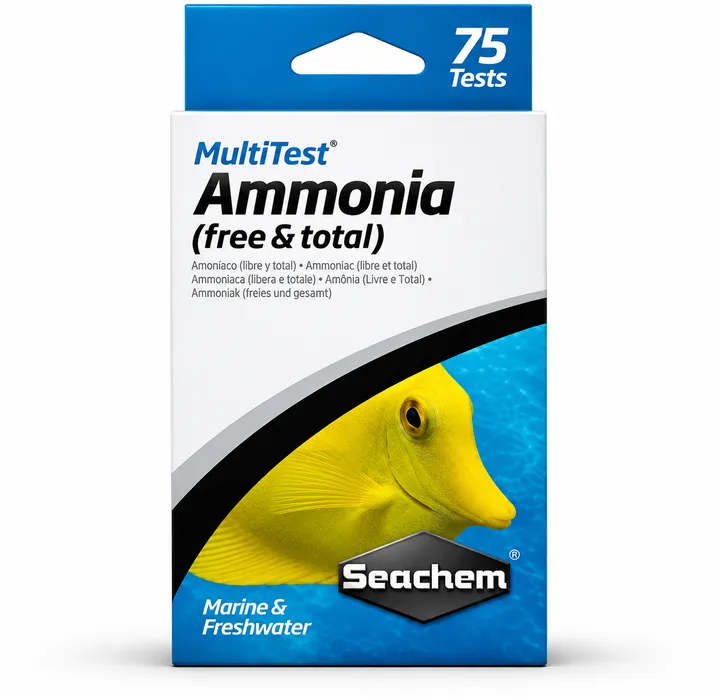
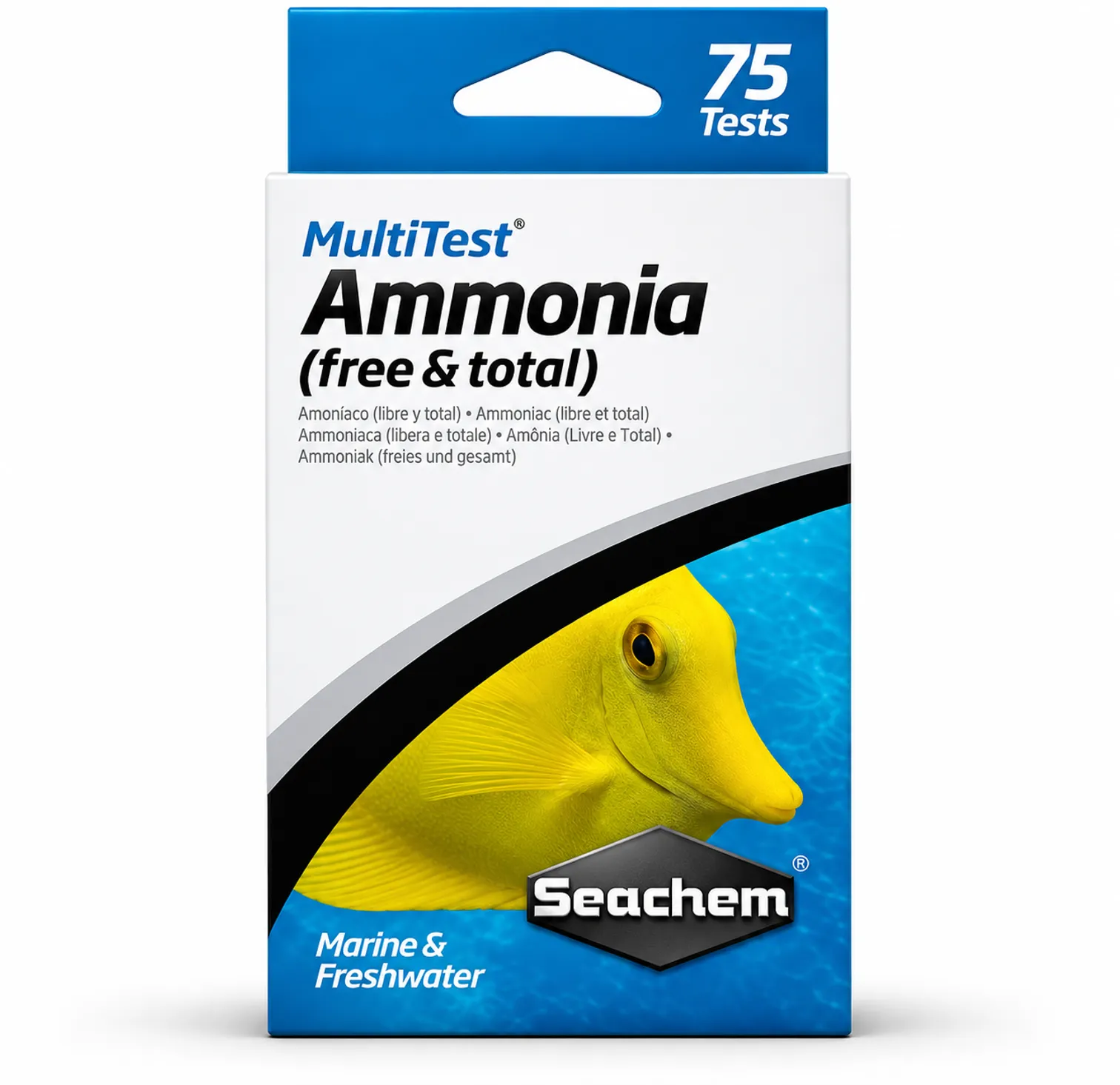
Seachem MultiTest Ammonia
Secure Checkout
Free Shipping*
Expert Support
Quality Guaranteed
7-Day Easy Returns. View Policy
Product Details
Description
Seachem MultiTest Ammonia Test Kit – 75+ Tests | Free & Total Ammonia (NH₃/NH₄⁺) Testing for Freshwater & Marine Aquariums
Product Description
Protect your aquarium livestock and monitor essential water quality with Seachem MultiTest Ammonia, a high-sensitivity aquarium ammonia testing kit designed to measure both free ammonia (NH₃) and total ammonia (NH₃ + NH₄⁺) in freshwater and marine aquariums.
Buy Seachem MultiTest Ammonia Test Kit Online in India at Aquatik Angels – Your Trusted Online Aquarium & Aquascaping Store in India and Chennai.
Manufactured by Seachem Laboratories, this advanced aquarium water testing kit uses specialized sensor-based technology to detect ammonia concentrations below 0.05 mg/L, helping aquarists identify potentially dangerous water conditions and assess biological filtration.
Ammonia is one of the most important water-quality parameters in aquarium fishkeeping. It is produced naturally through fish waste, uneaten food, decomposing plant material, and the breakdown of organic matter.
If ammonia accumulates, it can create stressful or dangerous conditions for ornamental fish and other aquatic organisms.
Seachem MultiTest Ammonia measures two important forms of ammonia:
-
Free Ammonia (NH₃): The more toxic un-ionized form that can directly affect aquatic livestock.
-
Total Ammonia (NH₃ + NH₄⁺): The combined concentration of free ammonia and ionized ammonium.
Measuring both forms provides valuable information about aquarium water conditions and supports more informed water-quality management.
The test kit uses Seachem's specialized gas-exchange sensor technology, which helps minimize interference from other dissolved substances.
Its free ammonia testing method can also provide meaningful readings when ammonia-binding water conditioners such as Seachem Prime, Safe, or AmGuard are being used, when the test is performed according to the manufacturer's instructions.
With over 75 tests, six reusable testing sensors, a convenient multi-cavity testing plate, a colour reference chart, and a reference sample for validation, Seachem MultiTest Ammonia provides comprehensive ammonia monitoring.
Suitable for freshwater aquariums, planted aquariums, tropical fish tanks, marine aquariums, reef tanks, aquarium breeding systems, and fish quarantine aquariums, this kit is an important water-testing accessory for aquarium hobbyists and professional maintenance specialists.
Key Features & Benefits
1. Free & Total Ammonia Testing
Measures both toxic free ammonia and the combined concentration of ammonia and ammonium.
2. High-Sensitivity Ammonia Detection
Detects concentrations below 0.05 mg/L, supporting sensitive aquarium water-quality monitoring.
3. Over 75 Tests
Provides extensive testing capacity for routine aquarium maintenance and repeated water-quality checks.
4. Freshwater & Marine Compatible
Designed for use in freshwater and saltwater aquarium systems.
5. Advanced Seachem Sensor Technology
Uses specialized gas-exchange technology for free ammonia measurement.
6. Reduced Chemical Interference
Designed to minimize interference from other aquarium water constituents.
7. Compatible with Ammonia-Binding Conditioners
The free ammonia test can be used when appropriate ammonia-binding conditioners are present, following Seachem's testing directions.
8. Reference Sample Included
Allows users to verify test performance when results appear unexpected.
9. Multi-Cavity Test Plate
Supports testing up to six samples simultaneously.
10. Easy-to-Read Colour Chart
Includes a viewing window to make interpreting test results more convenient.
11. Aquarium Cycling Support
Helps monitor ammonia concentrations while beneficial bacteria become established.
12. Early Detection of Water-Quality Problems
Supports prompt investigation of potentially harmful ammonia conditions.
13. Planted Aquarium Suitable
Useful for testing freshwater planted aquariums and aquascaping systems.
14. Reef Aquarium Compatible
Suitable for marine aquarium water testing.
15. Quarantine Aquarium Monitoring
Helps assess ammonia accumulation in fish quarantine and hospital tanks.
16. Professional Aquarium Maintenance
Suitable for regular aquarium water-quality assessments.
Technical Specifications
| Specification | Details |
|---|---|
| Brand | Seachem |
| Manufacturer | Seachem Laboratories |
| Product Name | MultiTest Ammonia |
| Product Category | Aquarium Water Testing |
| Product Type | Free & Total Ammonia Test Kit |
| Parameters Tested | Free Ammonia and Total Ammonia |
| Free Ammonia | NH₃ |
| Total Ammonia | NH₃ + NH₄⁺ |
| Detection Sensitivity | Below 0.05 mg/L |
| Testing Capacity | Over 75 Tests |
| Testing Technology | Gas-Exchange Sensor Method |
| Freshwater Compatible | Yes |
| Marine Compatible | Yes |
| Sensor Quantity | 6 |
| Multi-Cavity Test Plate | Included |
| Simultaneous Testing | Up to 6 Tests |
| Colour Chart | Included |
| Reference Sample | Included |
| Primary Application | Aquarium Ammonia Monitoring |
Understanding Ammonia in Aquarium Water
Ammonia is a nitrogen-containing compound produced by the decomposition of organic materials.
Common sources of aquarium ammonia include:
-
Fish waste and metabolic activity
-
Excess feeding
-
Decomposing fish food
-
Dead fish or invertebrates
-
Decaying aquatic plants
-
Accumulated organic debris
-
Insufficient biological filtration
-
Disruption of established beneficial bacteria
In a healthy, established aquarium, beneficial nitrifying microorganisms convert ammonia into nitrite and subsequently nitrate.
If the filtration system cannot process ammonia at the rate it is produced, ammonia may accumulate.
Regular testing helps aquarium owners recognize this problem before it causes severe livestock stress.
What Is Free Ammonia (NH₃)?
Free ammonia is the un-ionized form of ammonia.
It is significantly more toxic to aquatic organisms than ammonium.
Elevated free ammonia can interfere with normal fish respiration and damage sensitive tissues.
The amount of free ammonia present depends partly on the aquarium's pH and temperature.
As pH increases, a greater proportion of the total ammonia can exist as toxic free ammonia.
This makes careful ammonia monitoring particularly important in alkaline freshwater aquariums and marine aquariums.
Seachem MultiTest Ammonia directly measures free ammonia, helping aquarium owners better understand potentially harmful water conditions.
What Is Total Ammonia (NH₃ + NH₄⁺)?
Total ammonia is the combined concentration of free ammonia and ionized ammonium.
Ammonium is substantially less toxic than free ammonia under typical aquarium conditions.
However, changes in pH and temperature can alter the balance between these forms.
Total ammonia measurement helps aquarists assess overall nitrogen accumulation.
Testing both free and total ammonia provides useful information for aquarium maintenance and water-quality management.
Why Ammonia Testing Is Important
Ammonia monitoring is essential because elevated ammonia may occur even when aquarium water appears clear.
Common situations that can contribute to ammonia accumulation include:
New Aquarium Setup
Newly established aquariums may not contain enough beneficial bacteria to process waste effectively.
Overfeeding
Excess fish food decomposes and contributes to ammonia production.
Overcrowding
High fish populations can increase organic waste beyond the filtration system's capacity.
Filter Disturbance
Replacing mature biological filtration media or exposing it to harmful chemicals can disrupt beneficial bacteria.
Decomposing Organic Matter
Dead organisms and decaying plant material can release ammonia.
Quarantine Aquariums
Temporary quarantine systems may have limited or immature biological filtration.
Sudden Increase in Biological Load
Adding many fish at once can increase ammonia production before bacterial populations adapt.
Seachem MultiTest Ammonia helps identify these conditions through water testing.
Understanding the Aquarium Nitrogen Cycle
The nitrogen cycle is an important biological process in aquarium filtration.
It generally follows:
Organic Waste → Ammonia → Nitrite → Nitrate
Fish waste and decomposing organic material release ammonia.
Beneficial nitrifying microorganisms convert ammonia into nitrite.
Other nitrifying microorganisms convert nitrite into nitrate.
Nitrate can accumulate and is managed through suitable water changes and nutrient-export methods.
During aquarium cycling, ammonia and nitrite may increase before biological filtration becomes established.
Seachem MultiTest Ammonia helps monitor ammonia during this process.
However, ammonia testing alone cannot confirm that an aquarium is fully cycled.
Nitrite testing and assessment of biological filtration capacity are also necessary.
Seachem Sensor-Based Ammonia Testing Technology
Seachem MultiTest Ammonia uses a specialized gas-exchange testing method.
This technology enables sensitive free ammonia detection and helps minimize interference from other water constituents.
The manufacturer states that its free ammonia measurement method can be used when ammonia-binding conditioners, including Seachem Prime, Safe, and AmGuard, are present.
Correct testing procedures are essential to distinguish free ammonia from total ammonia.
The testing kit includes six sensors, a multi-cavity plate, a reagent for the total ammonia procedure, and a colour chart.
Follow Seachem's exact instructions for each type of measurement.
How to Use Seachem MultiTest Ammonia
Step 1 – Prepare the Testing Equipment
Ensure the supplied test plate, pipette, sensors, and other accessories are clean.
Step 2 – Collect Aquarium Water
Use the supplied pipette to obtain an aquarium water sample.
Step 3 – Prepare the Test Plate
Place the specified sample volume into the appropriate testing cavity.
Step 4 – Select the Testing Procedure
Choose whether to measure free ammonia or total ammonia.
Step 5 – Prepare the Ammonia Sensor
Handle the supplied sensor according to Seachem's instructions.
Use the supplied forceps where required.
Step 6 – Perform the Free Ammonia Test
Follow the manufacturer's free ammonia procedure, including the prescribed sensor placement and reaction time.
Step 7 – Perform the Total Ammonia Test
Use Total Ammonia Reagent 1 only as directed in the total ammonia procedure.
Step 8 – Read the Results
Compare the sensor's colour with the supplied ammonia chart.
Step 9 – Record the Readings
Record the measured ammonia concentration and testing date.
Step 10 – Validate if Necessary
Use the included reference sample if test accuracy needs verification.
Step 11 – Clean and Store
Follow Seachem's directions for sensor regeneration, storage, and cleaning of testing accessories.
Important: Free ammonia and total ammonia testing have different procedures. Use the exact manufacturer instructions for sample volumes, reagents, and reaction times.
How to Use the Reference Sample
Seachem MultiTest Ammonia includes a reference sample for validating test performance.
The reference sample is useful when readings appear inconsistent or unexpectedly high or low.
To validate a test:
-
Select the supplied ammonia reference.
-
Use the reference sample instead of aquarium water.
-
Perform the test according to the manufacturer's instructions.
-
Compare the result with the reference's specified value.
-
Review the procedure if the result differs significantly.
Reference testing is not required for every routine aquarium test.
The reference sample is for test validation and should not be added to the aquarium.
How to Interpret Ammonia Test Results
Ammonia results should be considered alongside aquarium pH, temperature, livestock condition, and biological filtration.
Free Ammonia
Because NH₃ is the more toxic form, detectable free ammonia requires careful attention.
If free ammonia increases, investigate the cause and take appropriate corrective action.
Total Ammonia
Total ammonia indicates the combined amount of NH₃ and NH₄⁺ present.
The potential toxicity of a total ammonia reading depends partly on the proportion present as free ammonia.
A total ammonia reading should not automatically be interpreted as an equivalent concentration of toxic NH₃.
Unexpected Readings
If results appear inconsistent with aquarium conditions:
-
Repeat the test using the correct procedure.
-
Check the test accessories for contamination.
-
Verify sensor handling and reaction times.
-
Use the supplied reference sample.
-
Consider pH and temperature.
-
Investigate recent changes to aquarium maintenance or chemical treatments.
Seachem MultiTest Ammonia for Freshwater Aquariums
Freshwater aquariums require effective biological filtration and routine water-quality monitoring.
Ammonia may accumulate following heavy feeding, sudden increases in fish population, filter disturbances, or decomposing organic waste.
The Seachem test kit helps aquarists assess ammonia levels and identify possible filtration problems.
It is suitable for tropical community aquariums, ornamental fish tanks, breeding systems, and newly established aquariums.
Seachem MultiTest Ammonia for Planted Aquariums
Planted aquariums contain fish, aquatic plants, substrates, beneficial microorganisms, and biological filtration media.
Ammonia may accumulate during aquarium setup, particularly when using certain nutrient-rich aquasoils.
It can also increase when significant plant material decomposes.
The kit helps aquascapers monitor free and total ammonia during aquarium establishment and maintenance.
Additional testing for nitrite, nitrate, pH, GH, and KH may be necessary depending on the aquarium.
Seachem MultiTest Ammonia for Marine Aquariums
Marine aquariums generally operate at relatively high pH.
At higher pH levels, a greater proportion of total ammonia may exist as toxic free ammonia.
Careful monitoring is especially important during marine aquarium cycling, fish introduction, and quarantine.
Seachem MultiTest Ammonia is compatible with marine water and can support routine saltwater aquarium maintenance.
Seachem MultiTest Ammonia for Reef Aquariums
Reef aquariums contain fish, corals, invertebrates, and beneficial microorganisms.
Ammonia accumulation can affect sensitive livestock and indicate biological filtration problems.
The kit is suitable for monitoring ammonia during reef aquarium establishment or when unusual water-quality conditions are suspected.
Additional water testing for alkalinity, calcium, magnesium, nitrate, phosphate, and salinity may still be necessary.
Seachem MultiTest Ammonia for Quarantine Tanks
Quarantine aquariums are used to observe newly acquired fish or isolate livestock for care.
Temporary quarantine systems may contain immature biological filtration.
Ammonia testing is especially important in these environments.
Seachem MultiTest Ammonia helps users monitor free and total ammonia during quarantine and identify potentially harmful conditions.
Seachem MultiTest Ammonia for Aquarium Breeding Systems
Breeding aquariums often contain eggs, fry, or juvenile fish that may be sensitive to poor water quality.
Feeding small fish frequently can increase organic waste.
Regular ammonia testing helps breeders evaluate water conditions and feeding practices.
Suitable filtration, aeration, and maintenance remain essential.
What to Do If Ammonia Is Elevated
Elevated ammonia requires prompt investigation.
Recommended general actions include:
-
Observe fish for rapid breathing or unusual behaviour.
-
Confirm the result with an appropriate test.
-
Check aquarium pH and temperature.
-
Remove uneaten food and decomposing organic debris.
-
Perform a suitable partial water change using properly conditioned water.
-
Increase aeration if necessary.
-
Assess biological filtration performance.
-
Reduce feeding temporarily when appropriate.
-
Use a suitable ammonia-binding conditioner when required, following product instructions.
-
Continue testing until aquarium conditions stabilize.
Avoid unnecessary replacement of mature biological filter media.
Do not raise aquarium pH abruptly when ammonia is present, as this can increase the proportion of toxic free ammonia.
Important Usage Precautions
-
Follow Seachem's official ammonia testing instructions.
-
Free ammonia and total ammonia require different procedures.
-
Handle the supplied sensors carefully.
-
Avoid touching sensor surfaces unnecessarily.
-
Use clean testing equipment.
-
Do not interchange reagent caps.
-
Never return tested samples to the aquarium.
-
The total ammonia reagent contains a strong alkali.
-
The sensor storage/regeneration gel contains a strong acid.
-
Avoid direct contact with skin and eyes.
-
If accidental contact occurs, wash the exposed area thoroughly with water.
-
If chemicals enter the eyes, immediately rinse with water for at least 10 minutes and seek medical attention.
-
Do not ingest the reagents.
-
Store the kit securely away from children and pets.
-
Use reference samples only for testing validation.
-
The kit measures ammonia but does not remove or detoxify it.
-
Take elevated ammonia readings seriously and investigate the underlying cause.
Frequently Asked Questions
What is Seachem MultiTest Ammonia used for?
It measures free ammonia and total ammonia in freshwater and marine aquarium water.
How many tests does the kit perform?
Over 75 tests.
What is free ammonia?
Free ammonia (NH₃) is the more toxic un-ionized form of ammonia.
What is total ammonia?
Total ammonia is the combined concentration of free ammonia and ammonium.
Does this kit measure both free and total ammonia?
Yes.
What is the detection sensitivity?
Seachem states that the kit detects ammonia below 0.05 mg/L.
Is Seachem MultiTest Ammonia suitable for freshwater aquariums?
Yes.
Can it be used in marine aquariums?
Yes.
Is it suitable for reef aquariums?
Yes. It can help monitor ammonia in reef aquarium water.
Can it be used in planted aquariums?
Yes.
Can it help during aquarium cycling?
Yes. Ammonia testing is important during biological filter establishment.
Does the kit include a reference sample?
Yes.
Why is the reference sample included?
It allows users to validate test performance using a known reference.
Does the kit include reusable sensors?
Yes. The package contains six sensors used according to Seachem's testing and regeneration instructions.
Can several samples be tested simultaneously?
Yes. The multi-cavity plate accommodates up to six tests.
Can it test ammonia when Seachem Prime is being used?
Seachem states that the sensor-based free ammonia method can be used when ammonia-binding products such as Prime are present, provided the manufacturer's instructions are followed.
Does this kit remove ammonia?
No. It is a testing kit, not an ammonia-removal treatment.
Does it measure nitrite?
No.
Does it measure nitrate?
No.
Can the kit replace biological filtration?
No. It provides water-quality information but does not perform filtration.
Is ammonia always visible in aquarium water?
No. Aquarium water can appear clear even when ammonia is elevated.
Why can ammonia increase in a new aquarium?
The biological filtration system may not yet contain sufficient beneficial nitrifying microorganisms.
Can high pH increase ammonia toxicity?
Yes. Higher pH increases the proportion of total ammonia present as free ammonia.
Can the kit be used in fish quarantine tanks?
Yes.
Is this suitable for professional aquarium maintenance?
Yes. Its testing capacity and simultaneous sample-testing design support regular use.
Package Contents
Seachem MultiTest Ammonia includes:
-
Total Ammonia Reagent 1
-
Sensor Container with 6 Sensors
-
Total Ammonia Reference Sample
-
Forceps
-
Sample Pipette
-
Ammonia Colour Chart
-
Multi-Cavity Test Plate
-
Manufacturer Instructions
Storage & Handling
Store Seachem MultiTest Ammonia according to the manufacturer's instructions.
Keep the reagent container securely closed.
Protect sensors from contamination and physical damage.
Follow Seachem's directions for sensor regeneration and storage.
Do not mix reagents or transfer them to unmarked containers.
Avoid direct skin and eye contact with testing chemicals.
Keep away from children and pets.
For aquarium water testing only.
Why Choose Seachem MultiTest Ammonia?
Seachem MultiTest Ammonia provides an effective way to monitor two important forms of ammonia in aquarium water.
Its specialized sensor technology measures both free and total ammonia with sensitivity below 0.05 mg/L.
The included reference sample supports test validation, while the multi-cavity plate allows several samples to be tested during one session.
With over 75 tests and compatibility with both freshwater and marine systems, it is a practical tool for routine aquarium maintenance, biological filtration monitoring, and water-quality management.
Why Buy Seachem MultiTest Ammonia from Aquatik Angels?
Aquatik Angels is a specialized aquarium and aquascaping store located in Nolambur, Mogappair, Chennai, Tamil Nadu, serving aquarium enthusiasts across India.
We specialize in freshwater aquarium equipment, marine aquarium supplies, reef aquarium essentials, planted aquascaping, aquarium water-testing products, biological filtration, customized aquariums, terrariums, paludariums, and professional aquarium maintenance.
Explore our range of Seachem aquarium test kits, freshwater and marine water conditioners, ammonia monitoring equipment, beneficial bacteria products, filtration media, and aquarium maintenance accessories.
Buy Seachem MultiTest Ammonia Online in India
Looking for Seachem MultiTest Ammonia Price in India, Buy Seachem Ammonia Test Kit Online, Free Ammonia NH₃ Test Kit, Total Ammonia Aquarium Tester, Marine Ammonia Test Kit Chennai, or Freshwater Aquarium Ammonia Testing Kit India?
Shop Seachem MultiTest Ammonia at Aquatik Angels, your online destination for professional aquarium water-testing products, marine aquarium supplies, freshwater aquarium equipment, and aquascaping accessories.
Visit our aquarium store in Nolambur, Mogappair, Chennai, Tamil Nadu, or order online with Pan-India Shipping to eligible serviceable destinations, including Bengaluru, Hyderabad, Mumbai, Pune, Delhi, Coimbatore, Kochi, and other locations across India.
Enjoy Free Delivery on eligible orders.
Shop Online: www.Aquatikangels.com
Aquatik Angels – A Touch of Nature Indoors.
Best Online Aquarium Shopping in India and Chennai.
Recommended Products
Customer Reviews


NO REVIEWS FOUND